


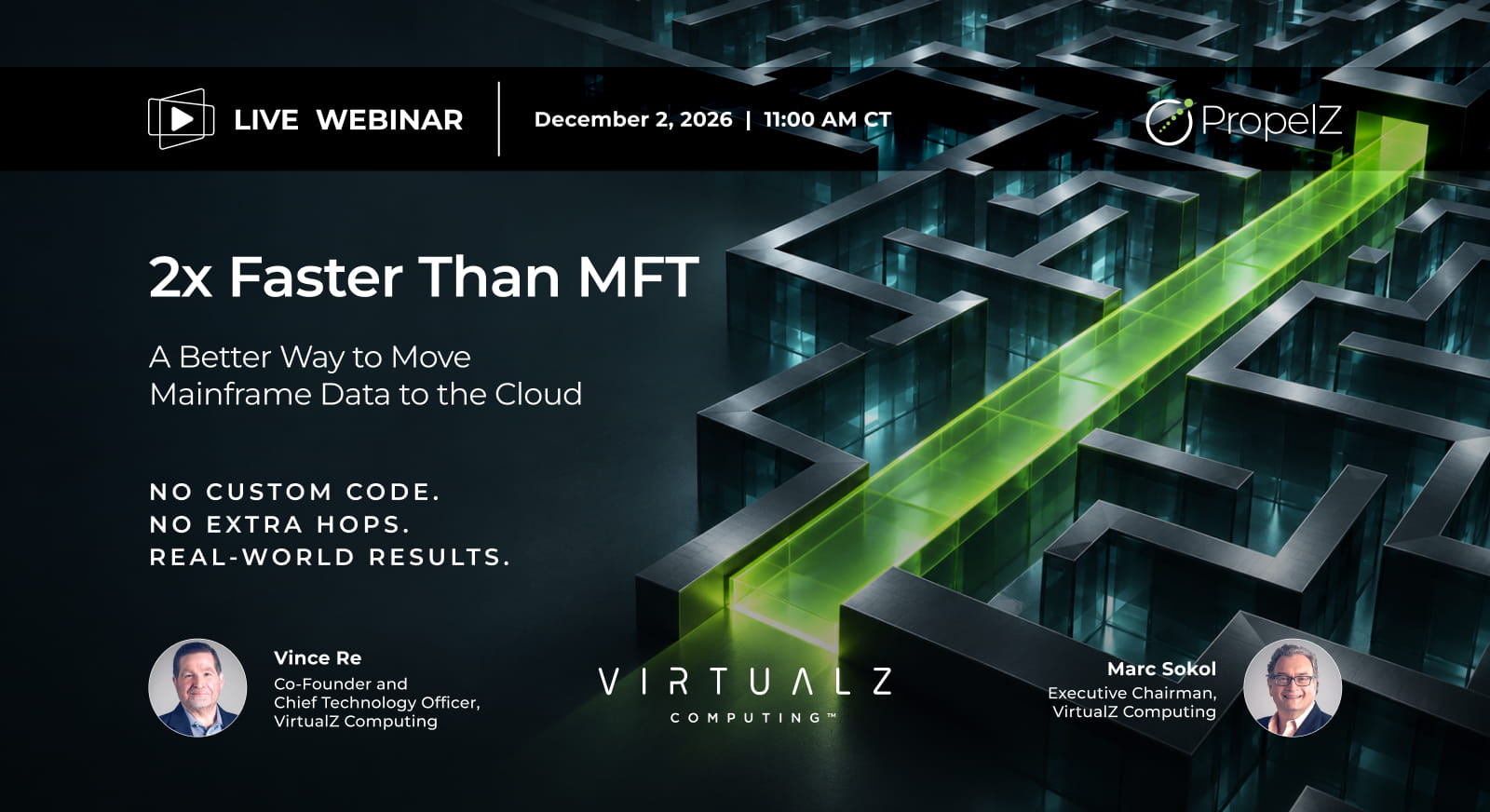
2x Faster Than MFT: A Better Way to Move Mainframe Data to the Cloud
200 million records. Two ways to move them. One finishes in half the time.
That’s not a projection — it’s what happened when an enterprise put its incumbent Managed File Transfer approach head-to-head against PropelZ, moving 100 to 200 million+ mainframe records to the cloud against live production data. Same datasets. Same targets. PropelZ did it roughly twice as fast, with full data integrity and zero disruption.
Here’s the uncomfortable part for anyone mid-migration: MFT was never built for this. It moves files between systems — fine. But point it at a mainframe modernization and the cracks show fast: throughput that stalls at production volume, brittle multi-step choreography, staging hops, per-file overhead that quietly adds quarters to your timeline. The tool isn’t broken. It’s just the wrong tool, and it’s setting the pace of your entire program.
PropelZ moves mainframe data — VSAM, sequential, GDG, tape, DB2 — straight to the cloud. No custom code. No staging platform in the middle. Just the data, moving.
In 30 minutes, we’ll open the hood: exactly where MFT burns time that PropelZ never spends, the two movement patterns enterprises actually run (database-staged and direct file-to-cloud), and what it looks like to pull an MFT-based path out of a live migration and replace it. Then we’ll run it and let the throughput do the talking.
If your mainframe-to-cloud plan is measured in quarters, it’s worth asking how much of that is the data — and how much is the tool moving it.
What you’ll see
- The head-to-head result — and the architecture behind the 2x difference
- A live mainframe-to-cloud move at production scale, no custom code, no staging
- Both movement patterns: PostgreSQL-staged and direct file-to-cloud
- Full-fidelity transfers of VSAM, sequential, GDG, and tape — with zero production impact
- What replacing an MFT-based path actually looks like, step by step
Who should attend
Enterprise and mainframe architects, migration and modernization leads, data platform owners — anyone whose mainframe-to-cloud timeline is being set by Managed File Transfer.
See PropelZ in Action
Join us on December 2 to see how PropelZ simplifies mainframe-to-cloud data movement and delivers faster results without custom code or unnecessary staging.
Can’t attend live? Register anyway, and we’ll send you the replay.
PropelZ vs. MFT: Frequently Asked Questions
Q. Is PropelZ faster than Managed File Transfer (MFT) for moving mainframe data?
Yes — in head-to-head enterprise testing against an incumbent MFT approach, PropelZ moved 100–200 million+ mainframe records to the cloud roughly twice as fast, with full data integrity and no production disruption.
Q. Why is MFT slow for mainframe-to-cloud migration?
Managed File Transfer was designed to move files between systems, so at mainframe-modernization scale it introduces throughput limits, multi-step choreography, staging hops, and per-file overhead that extend migration timelines.
Q. Does PropelZ require custom code or a staging platform to move mainframe data?
No — PropelZ moves VSAM, sequential, GDG, tape, and DB2 data directly to the cloud with no custom code and no intermediate staging platform.
Q. What data movement patterns does PropelZ support?
PropelZ supports two production-ready patterns — a PostgreSQL-staged path for relational landing and a direct file-to-cloud path for file-based workloads.
Q. Can PropelZ move mainframe data without disrupting production workloads?
Yes — PropelZ has been validated moving VSAM, non-VSAM, GDG, and tape datasets at 100–200 million+ record scale with no impact to existing production workloads and full data integrity.